
Research file · October 2026 · free to read
Recently, I met a business owner who clearly understood that AI now writes almost all the code. But facing his vendor, he did not know where he stood. Should he negotiate a lower price? Demand better quality? And above all, how could he check what the AI produces?
That is when I saw how much has changed. The criteria for choosing a developer or an IT vendor are no longer the ones we used before AI. In 2026, AI can produce very good code. What matters is what the developer does around it.
I run development teams in Vietnam for French companies, from Đà Nẵng. These tips come from my own experience. After each one, I point you to three articles from vendors, analysts or lawyers who go further, including when they disagree with me. Quotes from French, Vietnamese and German sources are my own translations.
1. Choose a developer who directs the AI instead of writing the code
A developer earns a place on a team because they do more than write code. In the past, getting better meant learning to write code, and better code every year. Today, if they still write their code by hand in your company, that is a bad sign. Give them AI tools so the AI writes it for them.
AI does not replace their critical thinking: writing good instructions, securing your infrastructure, reviewing what the AI did. For a single problem, AI can offer ten, even a hundred solutions. The developer becomes a decision-maker, the manager of their AI.
Take the notes of a meeting. From the same recording, a salesperson will ask the AI for a client meeting summary. I will ask it for the brief of the project that is starting. A developer will ask for the technical aspects, to plan the architecture. Same source, three results. It works the same way with code, every day.
So ask them to show you, end to end, how they handle a request with AI: a ticket, a module. Ask about their criteria, the way you would with a project manager or a CTO. The large companies and vendors I read reach the same conclusion, even if not every client is ready yet.
For further reading

 19 March 2026 · in FrenchStructural disruption in software engineering with generative and agentic AIThe voice of the CIOs of France’s largest companies: code “is becoming almost incidental, a material some call ‘disposable’”, and value is shifting to design and intent.
 21 August 2026AI reshapes India’s IT services sector contracts as clients demand more for lessV. Balakrishnan, former CFO of Infosys: “The pyramid model is gone. With coding agents, we no longer need basic coding.”
 FPT, reported by Vietstock · 16 April 2026 · in VietnameseMr Trương Gia Bình: AI is an irreversible game, the goal is to master core technologiesNot every client is ready. The chairman of Vietnam’s largest IT group admits that clients who let FPT code for them with AI account for only 1% of its revenue.
2. AI won’t divide your bill: negotiate quality first
If AI writes the code, why pay the same price? Many clients ask, and I understand why. The module that took a month now takes a week. The project promised in six months ships in one. The temptation is to pay for a week, or a month.
In project management, we reason with the project management triangle. In the middle, quality. Around it, three sides: price, time and scope, meaning what you ask for. Take an e-invoicing module, a hot topic in France right now. With AI, time drops sharply, and maybe price too. Scope, however, does not shrink. It can even grow, since everything goes faster and costs less.
My advice: if your requests do not change, negotiate price or time. Otherwise, use the gain to demand more quality and more scope.
Do not squeeze too hard either. Your vendor still pays salaries, has to train people, and AI tools are not cheap. If your project no longer pays enough, they will turn it down and move to more profitable clients. And a deadline that is too tight costs you quality. AI-generated code is often very generic. Standing out takes time: reviewing, re-prompting, and getting humans together to decide to go beyond the first result. That is where your team’s real value lies.
I have seen companies panic and offer clients partnerships paid on results, per subscription for example. They regret it: these deals are slow to set up, and they complicate the relationship. For me, the right balance is still the man-day, with a variable part tied to results: a bonus if quality goes up, a penalty if it drops. Part of the industry is starting to sign contracts like this.
For further reading

 31 March 2026AI is altering the economics of software development, but who gets a cut?Asia Solnyshkina, founder of the development firm ProSense.Digital, to clients asking for 20 to 30% off: “So no, we are not cutting prices simply because Claude Code exists.”
 21 August 2026 · in FrenchIT services: how AI is changing service contractsCharles Mauclair, head of the IT services group at Numeum, the French digital industry body: for years, firms sold time and profiles, “but today, clients no longer buy time… they buy results.”
 28 April 2026CIOs move to reclaim value as AI shakes up outsourcing contractsA sharper view than mine on the man-day, from a former CIO: “The FTE model incentivizes bad behavior. If you pay by the FTE, why would your provider use AI? That would reduce their revenue and margin.”
3. Capture the AI gain by setting deliverables month by month
So how do you get your share of the gain? This is the core of my method, the one I use with my clients over time: goals set every month.
I no longer commit for five years, or even one. Everything changes too fast, and the AI models that write code get more efficient and cleaner every month. So every month, you review with your developers. You start from what they delivered last month, and together you set the list of what they will deliver next month.
Then ask yourself: if I pay this developer a few thousand euros a month and they deliver this, does my business gain from it? Will my users be better served? You run the company, so the call is yours. If you hire a project manager, ask them to apply this method.
This is my way of sharing the savings from AI: you see them in what gets delivered, not just in a lower cost or saved time.
For further reading
 10 September 2026IT consulting has a big AI problemFive-year contracts are turning into renewable six-month ones. A former CIO advises checking whether AI makes the engagement faster for the client, or simply more profitable for the firm.
 13 January 2026Webinar: how to buy AI-first deals that deliverBuyers prefer a fixed fee with an outcome bonus (56%), far ahead of time and materials (18%). But 73% find outcomes hard to define.
 20 August 2026As AI changes pricing, IT firms see uptick in outcome-based dealsTech Mahindra signed a healthcare contract indexed to roughly 40% fewer tickets. Yet for now, “almost everything [is] still skewed towards the traditional T&M and fixed price models.”
4. Require a named human to answer for every line the AI writes
In 2026, if there is a bug in your software, chances are an AI wrote it. But who answers for it? You are not going to cancel your ChatGPT subscription.
What matters most is knowing who produced which line of code. An AI assistant or agent must always be tied to a human, and that human answers for their agent. Making everyone accountable stops the race towards reckless automation. And the human keeps their value: they direct the AI, they guarantee security, and when the platform goes down, they know where the failure comes from, which line caused it, when, and for which ticket.
In practice, require two tools. Git first, the log that keeps every change to the code with its author and date. Then a task management tool, to trace each change back to the request behind it and the problem it was meant to solve. A poorly reviewed bug is not necessarily serious: what matters is finding where it came from.
What you want to avoid is spaghetti: everything works because AIs do everything, and at the first problem you have to re-prompt the agent, or even spend a day reconfiguring the whole platform.
For further reading

 Thoughtgears · 4 August 2026Mixed Human-AI Development Teams: How to Size an Offshore Team When AI Writes the First DraftA provider of dedicated teams in Southeast Asia: “Size the team on how much code it can responsibly verify, not how much it can produce.”
 21 September 2026AI Deliverables and Liability: Considerations for Risk AllocationA law firm’s view of defects introduced by AI. Vendors point to AI’s probabilistic nature and the client’s duty to review; the firm suggests a split written into the contract.
 17 August 2026Is Your Offshore Vendor Governance Ready for AI?First question to ask: which AI tools do your engineers use on our code? “A vendor that cannot answer the first question specifically does not have the internal visibility to govern it.”
5. Judge a developer’s seniority by how well they know your business
We no longer judge an experienced developer by their years of coding. For me, the better they know your industry, the more senior they are. They understand your requests, because they know where they come from.
With AI, every industry will move faster and faster. Your developer has to follow your market and how your customers are changing. It is a new criterion, to the point that you can index their salary to how well they know your business. They will save you a huge amount of time when writing technical specifications, then when reviewing AI-generated code, which is often generic or poorly suited to your industry. That critical eye is what you expect from an expert.
Experience still counts, though. I will always trust someone who has been coding for fifteen years more than a beginner who was handed ChatGPT and does not know what a technical architecture is.
For further reading
 30 March 2026 · in VietnameseIT students face fewer job openings if they “only know how to code”Rikkeisoft, an IT firm in Hanoi: “We don’t need people who can only code. They also need to understand the client’s needs and have a broader view of the product.”
 KPMG and Numeum · 8 October 2026 · in FrenchIT services and ICT, 2026 study: AI is upending business modelsAcross nearly 200 IT services firms in France, the most sought-after skill is now critical thinking and validating what AI produces (39%).
 9 February 2026Takeaways From The Future Of Software Development Retreat: Just Because You Can Doesn’t Mean You’re Ready ToAnother take on seniority: “the room agreed that we’ll start hiring junior programmers again […]. It’s the mid-career engineers […] that we realized are in trouble.”
6. Require documentation that survives your developer leaving
What if that developer leaves tomorrow? If they write all the instructions, control everything and know everything about your business, your company risks losing its momentum. Even at the end of a project: a developer who knows your business keeps suggesting improvements, and it is worth keeping them on a monthly basis.
In 2026, it is no longer acceptable to be told: “That button? Ask your robot what it does.” Require documentation, and documentation that everyone in the company can read. It is essential to the lifespan of your project.
An example. In customer support, someone sees an automatic email go out and is surprised. They should be able to open the list of email templates and read: this one is sent when an order status has not changed for three days. They understand why the customer got it, maybe spot a problem, and send a clear request to the developer, who will untangle the code with AI.
Imagining that your developer could leave does not mean you want to let them go. It means it is up to them to show you how your platform works, so that anyone in the company can understand it.
For further reading

 7 August 2026Vietnam Software Outsourcing Companies: How to Choose 2026Shogo Harada, the firm’s CEO: “Every list I have read compares vendors on size, rate and certification, and none of them ask what happens to your system on the day the person who understood it best stops working on it.”
 13 August 2026How To Choose A Software Development Partner In VietnamA Vietnamese development firm: “Product knowledge should not remain with one person. Instead, it should be stored in project documents, source code, tickets, and decision records.”
 17 June 2026AI & Outsourcing Series: The New Outsourcing EquationThe protections to write into the contract against lock-in: access to documentation and specifications, source code escrow, and exit assistance.
7. What AI doesn’t change: steering, a short trial, checking references
Some rules still hold with AI. Clients forget them at the start, and they come back to bite at the end.
How you steer matters more than the country. With a system that builds trust and transparency across the team, you can work with almost any country, remotely and across time zones. I have managed Macedonians, Vietnamese and French teams, and these methods are what made it work. The right question is not only how much it costs, but how many hours you win back by handing the work to a professional.
Start small. I cannot say it enough: avoid huge specifications and long tenders. If you cannot shrink the scope, hand over small, low-risk tasks in the first month. If they are done badly, you adjust, or you stop freely, with no one-year commitment. I apply this to my own clients too.
Check references yourself. Do not trust the sales brochure. Pick up the phone and call the references they list, especially projects in your industry, the way you would call a candidate’s former manager.
Put security on the table from day one. On small projects, nobody mentions it until the day something breaks.
Fix before you switch. If your current vendor does not tick every box, do not replace them at the first bump. Put your cards on the table and agree on a timeline to fix what is wrong. Changing vendors costs a lot of money, like replacing an employee, and above all a lot of your time.
For further reading

 29 May 2026The complete guide to outsourcing software development“Pilot first, contract second.” And: “Leaning on the vendor’s own pitch deck and hand-picked references is not due diligence.”
 8 June 2026Vietnam vs. India for Software Outsourcing: How to Choose in 2026“Vendor first. A strong, well-matched vendor in either country will outperform a weak one in the country that looks better on paper.”
 2016 · in FrenchFirst case law on sharing liability when agile IT contracts go wrongTwo Paris Court of Appeal rulings: a client who did not put reservations in writing at each delivery cannot contest everything at the end.
The 7 questions to ask your developer
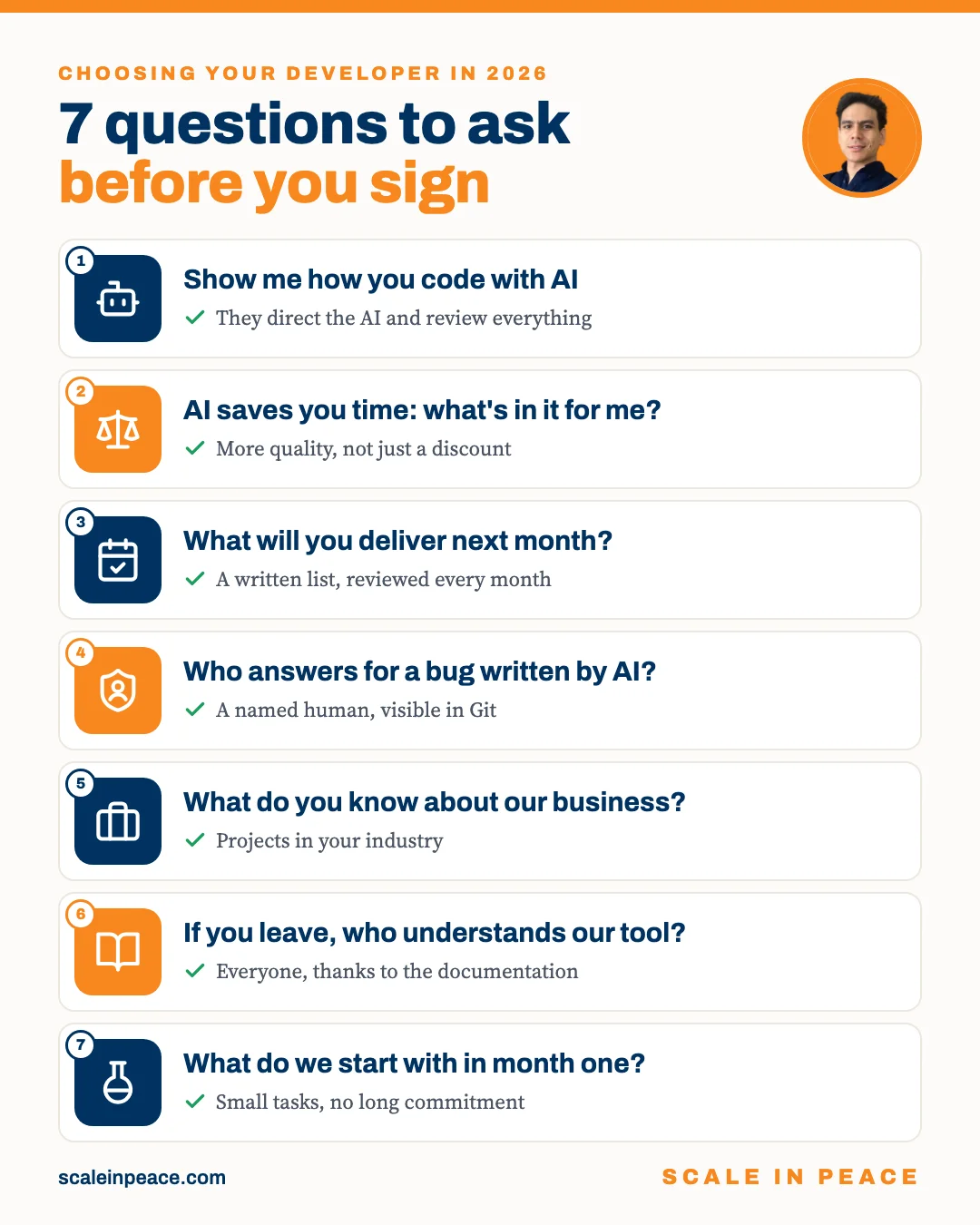
These seven tips come down to seven questions, to ask before you sign or to the team you already have. Click the image to enlarge it, or save it to your phone.
What should we call these new teams?
One last change, a broader one. More and more, we put an experienced developer with a project manager, or two juniors with a senior. These are tiny teams that move ahead like scouts. A single developer with ten well-configured AI agents can work miracles where you used to need ten specialists. This is the new tech team of 2026.
I have seen the term “AI Pods”, but I do not want the word AI in it: these are humans who use AI. I am looking for a name. If you have an idea, leave it in the comments.
Running a tech team in Vietnam?
If you already have a team of developers in Vietnam and managing it takes more of your time than you planned, that is exactly what I do with Offshore Under Control: I take the day-to-day management of your team off your hands, on the ground, in both cultures, so you never have to become a project manager yourself.
Not ready for a call? The free guide, “Succeed with your tech project in Vietnam”, walks through the method step by step.
Leave a Reply